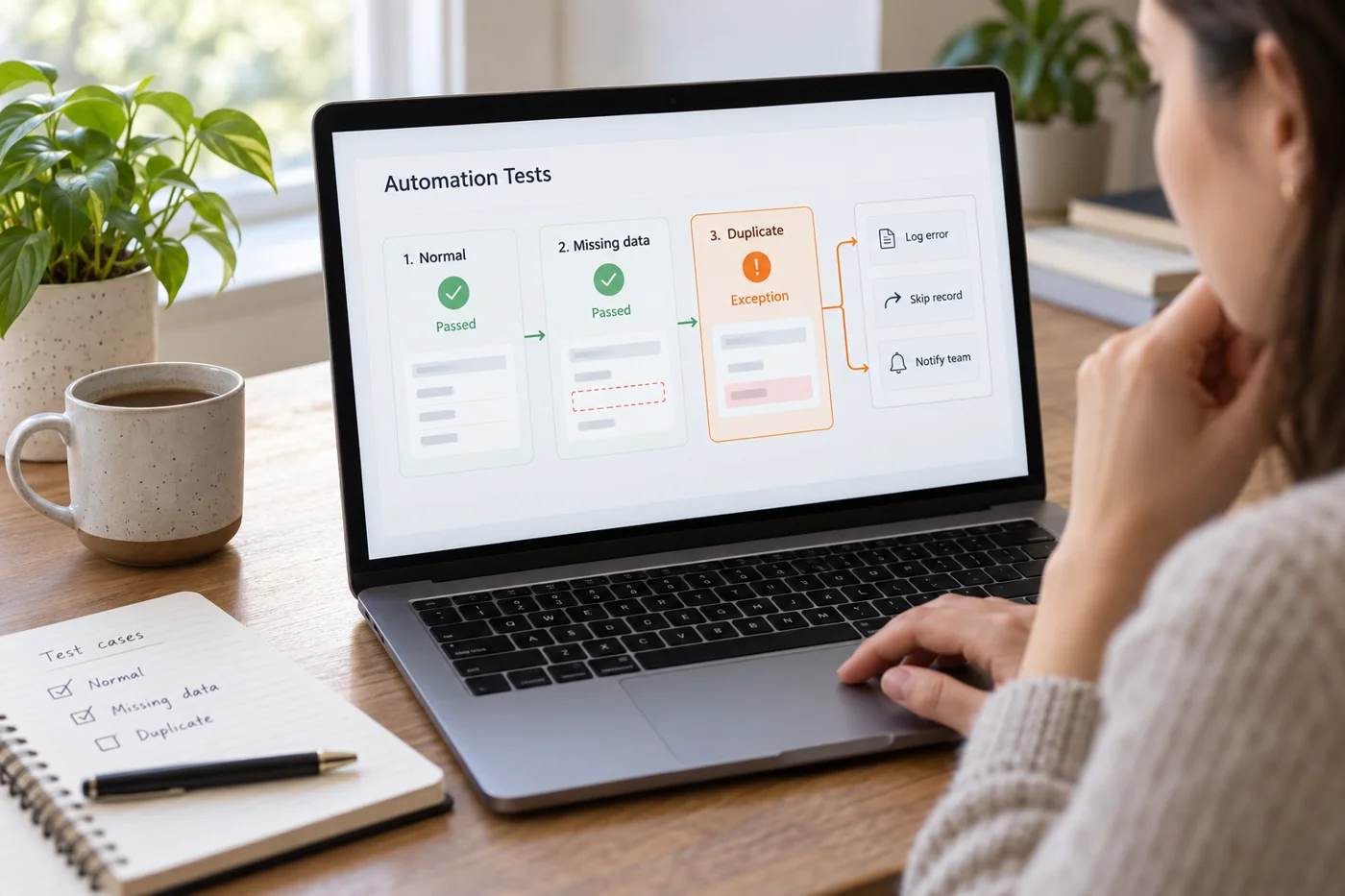
Define success in working terms
First state what a correct run accomplishes. For example, exactly one task is created with the right owner and a reference to the original input. A technical success state is insufficient: a flow can use the wrong person or field without reporting an error.
Separate three questions. Did the flow start? Did its individual actions execute? Is the outcome correct? Microsoft’s cloud-flow troubleshooting guidance similarly distinguishes trigger, action and logic problems. This helps investigate the right part of a failure.
Test missing and unusual inputs
Create one case without an optional value and another without a required value. The first should use an agreed fallback or omit the field. The second should visibly require clarification rather than invent a plausible but incorrect value.
Try longer text, special characters and values near an expected boundary. If only certain states are allowed, include an unknown state. These cases reveal whether the rule is actually clear or merely works with the first example used.
Do not use real external recipients during testing unless delivery itself is being explicitly and carefully checked. An internal test area or designated test address limits the consequences of mistakes.
Account for duplicate triggers and retries
Start the same business case twice in the test environment. Check whether a second task appears or the existing one is recognized. Decide beforehand which behavior is wanted. A repeated technical request does not always represent a new inquiry.
Consider a partially completed run. If the task was created but notification failed, restarting everything may duplicate the task. A retry route therefore needs to account for the state already reached. The technical implementation depends on the tool.
Document the connection between the input reference and generated result. Without it, determining whether an entry needs reprocessing or only a notification was missed becomes difficult.
Simulate interruptions carefully
In an appropriate test environment, try a missing destination or deliberately restricted test permission. Do not alter production access for this purpose. Observe whether a useful error state appears and whether the responsible person actually sees it.
Distinguish temporary availability problems from persistent configuration mistakes. Repeated restarts will not fix an incorrectly named destination. Testing should reveal the information available for diagnosis and which step can be checked safely without further changes.
Detect a silent error
A revealing test uses two similarly named destination areas. Check that the output really reaches the intended one. A write operation can succeed technically while an incorrect selection produces the wrong working result.
Compare the input reference with the entry actually created and its destination. Counting successful runs alone might miss this fault. The case demonstrates why a business-level sample check may be needed alongside technical error reporting.
After correcting the mapping, review previously created results separately. A repaired rule does not automatically move earlier misplaced entries to the right location. Record the required cleanup and who confirms its completion.
Keep a small case list
For each case, record the input, expected result, actual result and required correction. Reuse this list after later changes. It need not cover every conceivable event, but it should include essential working rules and known exceptions.
After a correction, repeat the affected case and one normal run. Changing an exception route can accidentally alter ordinary behavior. Both must work before the correction is verified for that scope.
Finally, name the operational checking route. Who reviews failures, how are they matched to cases and when is the automation paused because results are unclear? This makes testing part of actual ownership rather than a one-time demonstration.