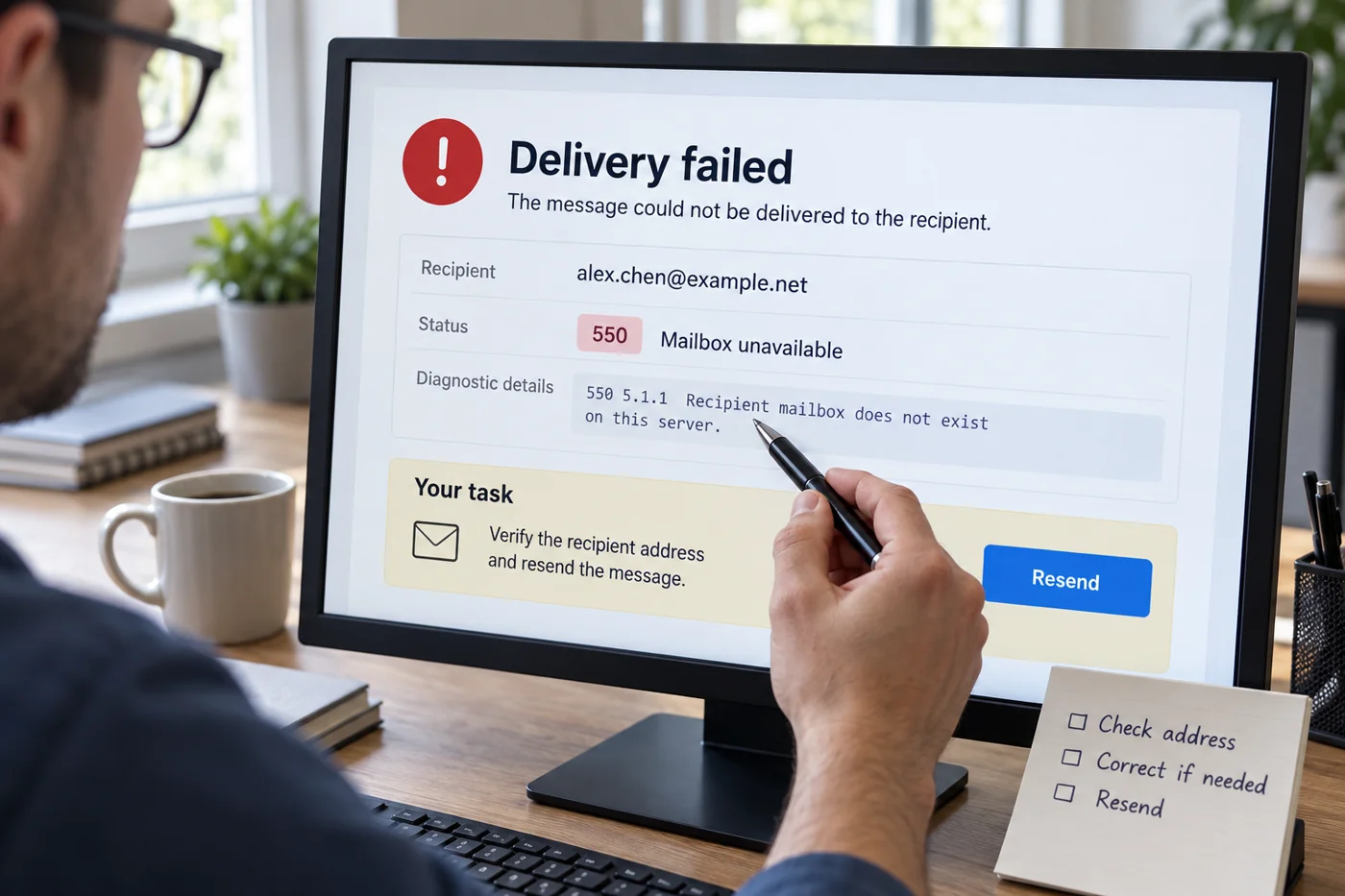
Match the notice to the message
Compare the recipient address, time and subject with your sent message. With several recipients, the notice may concern only one of them. Do not therefore assume that nobody received it. If the report matches no known sending attempt, record that uncertainty as a separate finding.
Keep the complete error text. A brief opening summary may be followed by more specific technical information. Those details are often more useful to the responsible support contact than your own paraphrase. Remove content that is unnecessary for investigation without losing the actual error code or relevant diagnostic wording.
Choose the next action from the evidence
For an unknown-recipient notice, check the entire address and confirm it through a known contact route. An autocomplete suggestion may contain an earlier address. Do not try a guessed spelling when the message contains confidential information.
For a temporary problem, read whether the service says it will make further delivery attempts. A rejection involving sending configuration or authentication belongs with the responsible technical person. Changing the message text does not automatically fix the sending route. Gmail's guidance likewise distinguishes several causes rather than treating every returned message alike.
Do not treat several recipients as one outcome
A project message might go to three confirmed contacts, with a failure notice for only one address. Check which recipient the technical section names. Sending again to the whole group may give two people unnecessary copies while the third remains unreachable. Clarify that missing route first.
Once a corrected address is confirmed, decide deliberately whether to repeat only the failed delivery or resend the whole conversation state. Label the repeated message clearly. Where partial delivery is possible, a brief check through a known contact method helps avoid different people receiving different editions of the same document. Keep the decision with the original failure report so another colleague understands why the second message was sent.
Separate urgency from technical repair
If the matter is urgent, use an already confirmed alternative contact route and briefly explain that the email attempt failed. That need not trigger improvised changes to domain or security settings. The underlying business conversation and the technical investigation can proceed separately.
After a confirmed correction, send a clearly labeled test and ask the recipient to confirm arrival. Record what changed and whether the same fault recurred. A failure notice is resolved when the affected route has been clarified or a named owner has accepted the remaining investigation. Keep that distinction visible rather than closing the task merely because a new test was sent.